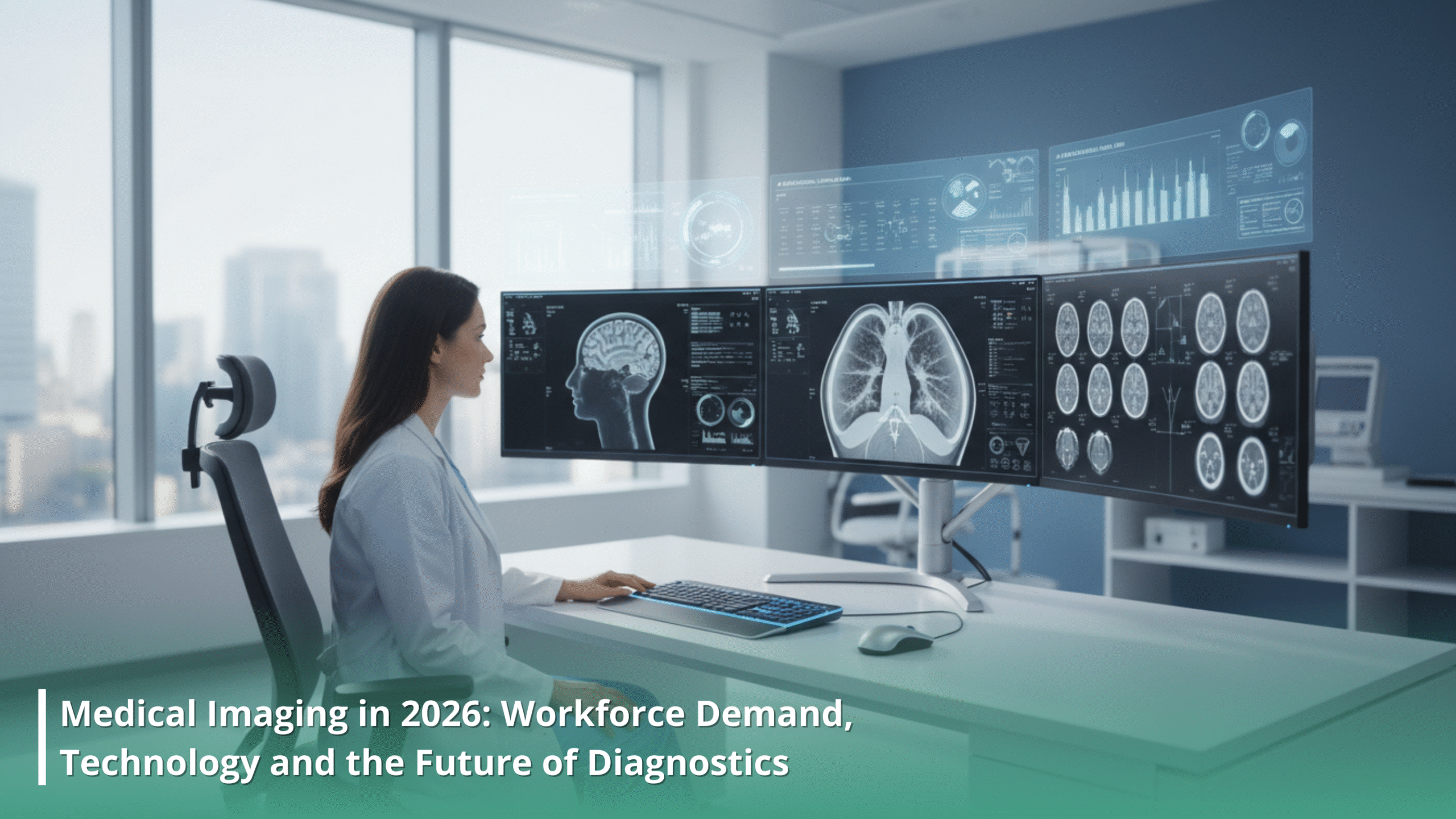
The landscape of medical imaging continues to evolve at an unprecedented pace this year, marked by transformative technological advances alongside significant workforce challenges. As healthcare systems worldwide grapple with increasing imaging volumes and staff shortages, the field stands at a critical juncture where innovation and strategic planning will determine the future of diagnostic healthcare.
Medical Imaging Workforce Crisis Intensifies Across Healthcare Systems
The medical imaging workforce shortage has reached critical levels, with radiologist attrition rates jumping 50% higher since the COVID-19 pandemic began in 2020. This persistent shortage affects not only radiologists but also radiographers, creating a cascading effect throughout healthcare delivery systems. Current projections indicate that radiologist supply will increase by approximately 26% through 2055, whilst imaging utilisation is expected to grow between 17% and 27% during the same period, meaning the shortage will likely persist without intervention.
Radiographers face acute labour shortages, with vacancy rates rising sharply to 18.1% in 2023 from just 6.2% three years earlier. Healthcare providers require approximately 16,000 additional imaging technologists annually to meet current demand, yet training programmes haven’t kept pace with this growing need. The shortage is most severe in specialised areas such as MRI, CT, nuclear medicine, and interventional radiology, where advanced training and experience requirements limit the available talent pool.
Multiple factors contribute to the medical imaging workforce crisis. The ageing population drives increased demand for diagnostic services, whilst the number of federally funded residency positions has remained relatively flat for three decades. Additionally, medical advances have transformed cancer into a chronic disease requiring ongoing imaging surveillance, whilst the complexity and number of images per study have increased significantly, making each examination more time-consuming to interpret.
Artificial Intelligence Integration Transforms Medical Imaging Workflows and Efficiency
Artificial intelligence has moved beyond experimental applications to become an integral component of modern medical imaging practice. AI is enabling radiology departments to transition from manual task execution to autonomous workflow intelligence, with applications managing logistics and freeing specialists to focus on interpretation and patient care. The medical imaging AI market is experiencing remarkable growth, with projections showing the field could reach significant value as healthcare systems increasingly adopt these technologies.
In this year, medical imaging professionals are leveraging AI across multiple domains. AI-powered tools assist with automated scheduling, image quality checks, lesion measurement, and report generation. Advanced algorithms can identify hard-to-detect abnormalities, reduce repetitive data-entry tasks, and automatically append electronic health records with imaging and diagnostic data. Perhaps most significantly, AI enables predictive analytics that help reduce unnecessary imaging and prioritise high-value examinations.
However, experts caution that whilst AI offers substantial benefits, it doesn’t necessarily reduce overall radiologist workload. Instead, AI serves as an augmentation tool that enhances diagnostic accuracy and efficiency rather than replacing human expertise. Partnerships between major healthcare technology companies signal a broader industry shift towards imaging-driven robotics and augmented reality as engines of growth. This evolution positions medical imaging at the forefront of precision medicine and personalised healthcare delivery.
Advanced Medical Imaging Technologies Reshape Diagnostic Capabilities and Patient Experiences
The technological sophistication of medical imaging equipment continues to advance rapidly. Modern CT scanners can now reduce radiation exposure by 50% to 75% compared to conventional approaches whilst maintaining or improving image quality. CT scans remain essential for contemporary medical diagnostics thanks to developments in resolution, velocity, radiation dose reduction, AI integration, and personalised treatment. Advanced imaging techniques like volumetric quantitative CT and high-resolution CT provide three-dimensional visualisation of bone structures and aid in measuring bone mineral density and strength.
MRI technology has evolved to address historical limitations, with systems designed to improve accessibility, shorten scan times, and produce better-quality images. High-resolution ultrasound and advanced applications such as contrast-enhanced ultrasound improve tissue characterisation and blood vessel visualisation. The rise of theranostics, which combine therapeutic and diagnostic radiopharmaceuticals, is boosting demand for nuclear medicine imaging, with treatments requiring advanced imaging such as PET and CT to select appropriate patients and track treatment effectiveness.
The integration of augmented and virtual reality into medical imaging represents another significant advancement. Three-dimensional medical imaging technologies allow physicians to examine realistic, textured visualisations of body structures from every angle, enabling more accurate surgical planning and patient education. Mobile and wearable imaging devices are expanding diagnostic capabilities beyond traditional clinical settings, allowing for continuous patient monitoring and data collection in real-world environments.
Medical Imaging Drives Personalised Medicine and Predictive Healthcare Delivery
Medical imaging combined with AI is enabling in-silico medicine, creating computational patient models for predicting outcomes and supporting precision prevention and proactive patient management. This transformation shifts radiology from reactive disease detection to anticipatory care architecture, where imaging data predicts and prevents disease before symptoms appear. Radiologists are evolving from report generators into proactive care architects who guide diagnosis, predict disease trajectories, and inform treatment decisions.
Personalised medical imaging has become a defining trend, reshaping diagnostics and therapy planning through patient-specific pathways. Cloud-first imaging infrastructure replaces legacy systems, enabling real-time collaboration between imaging departments, clinical teams, and AI agents in unified platforms. Future systems automatically fuse radiological images with data from genomics, wearables, electronic health records, and laboratory results. This multimodal data integration provides comprehensive patient insights that support precision therapeutics and individualised treatment strategies.
The shift towards value-based care is influencing medical imaging procurement and utilisation. Healthcare providers increasingly prioritise clinical outcomes, cost-effectiveness, and long-term patient impact when making equipment purchasing decisions. Lifecycle management has become central to procurement strategies, with hospitals optimising equipment performance through preventive maintenance and incorporating upgrades that extend usability whilst ensuring diagnostic quality and sustainability.
Medical Imaging Accessibility and Care Delivery Models Evolve to Meet Population Needs
The democratisation of medical imaging services represents a significant trend reshaping healthcare delivery. A clear trend in recent years has been the shift of imaging services from large hospitals into outpatient and community settings. This decentralisation improves patient access to diagnostic services whilst reducing healthcare costs and wait times. Teleradiology has become essential for ensuring timely diagnoses in underserved and remote areas, enabling hospitals regardless of location to secure radiology coverage and maintain quality care standards.
However, this expansion of access raises important questions about healthcare equity. As medical imaging becomes more integral to diagnosis and treatment, ensuring all patients can access advanced imaging technologies regardless of geographic location or socioeconomic status becomes increasingly critical. Healthcare organisations must balance the need for sophisticated imaging capabilities with practical considerations of equipment costs, staff availability, and reimbursement structures.
Recent budgetary pressures across many healthcare systems have accelerated a shift in the diagnostic medical imaging market towards mid to low-priced products, with purchasing decisions influenced by both upfront costs and overall operational value. This trend has enabled challenger vendors to compete effectively against established suppliers, potentially expanding access whilst maintaining quality standards. The ongoing evolution of reimbursement models will significantly influence how medical imaging services are delivered and which technologies become widely adopted in diverse healthcare settings.
The medical imaging field currently stands at the intersection of unprecedented opportunity and significant challenge. Whilst workforce shortages threaten to constrain access to essential diagnostic services, technological innovations offer pathways to enhanced efficiency and improved patient care. Success will require coordinated efforts amongst healthcare organisations, educational institutions, policymakers, and technology developers to expand training capacity, optimise workflows, reduce unnecessary imaging, and ensure equitable access to advanced diagnostic capabilities. As artificial intelligence, personalised medicine, and innovative technologies continue to mature, medical imaging will remain central to modern healthcare delivery, demanding strategic investment and workforce development to meet the evolving needs of patients worldwide.